Is the Flying Tesla Roadster Real? Ramp & Kickflip Stunts Explained + a Fan-Made Parody Game
Published
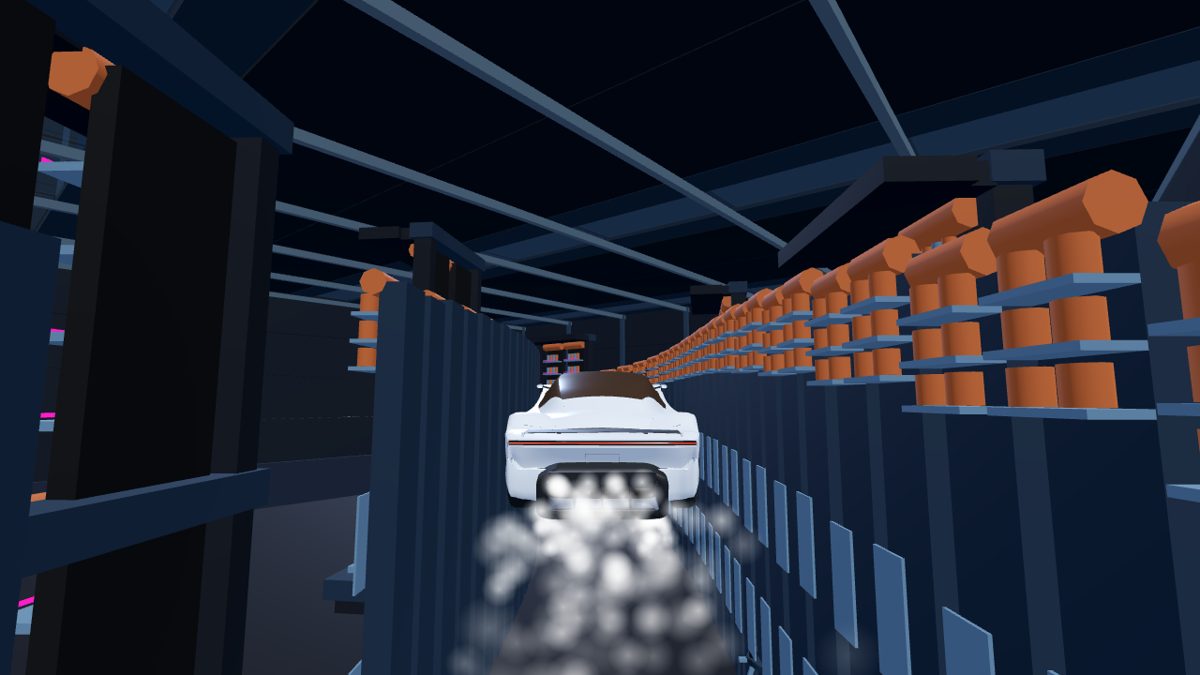
Short answer: yes, the October 15, 2026 demo really happened in front of a live audience, and it was not AI-generated. But "flying car" needs an asterisk. Below we go stunt by stunt — the ramp, the kickflip, the 0–60 run — and separate what was shown live from what is Tesla's claim.
What actually happened on October 15
Tesla showed its next-generation Roadster at a SpaceX test site in McGregor, Texas, near Waco. The event was livestreamed with a live audience on site (CNBC). The show lasted under 30 minutes and centered on two stunts plus an acceleration run (The Verge).
The "is it AI?" question came up because the clips look like CGI. Google Trends logged breakout searches such as "is the flying tesla real" after the event, and Merca2.0 reports Musk himself said a live audience was needed to show it was not AI (Merca2.0). So the footage is real. What it proves is narrower than the headlines.
Stunt 1: The ramp (upside down, then a flip to the ground)
What was shown: the car drove up a tall, curved, C-shaped ramp, stopped while hanging upside down, then launched off the top, rotated in mid-air and came down slowly on its thrusters (Engadget, CNBC).
How Tesla says it works: a fan-based suction system under the car pulls air from beneath it, which Tesla says can hold the car upside down even when stopped. The Verge reports it can generate up to two Gs of suction. The soft landing comes from cold-gas thrusters with electric actuators that make tiny corrections in a fraction of a second (The Verge, Engadget).
Verdict: Real event, filmed live. The suction and thrust figures are Tesla's claim.
Stunt 2: The kickflip over parked vehicles
What was shown: later in the show, the car used its thrusters to hop over a line of parked Tesla vehicles, including a Semi truck, and rolled in the air before landing. Tesla engineering VP Lars Moravy called it "a kick flip" (The Verge; Reuters via Mint). Aviation Week called it an axial roll on a short hop (Aviation Week).
How it works: attitude-control thrusters around the body plus main thrusters at the rear. The gas is compressed air, not rocket fuel. The Verge reports two high-pressure tanks holding about 250 kg of air and 10 nozzles, and that the car can refill its own tanks (The Verge). Electrek adds that carbon-fiber pressure vessels fill every usable space, so more gas means more "flight time" (Electrek).
Verdict: Real stunt, filmed live. How the thrusters and gas tanks work is Tesla's claim (as reported above).
Who was in the car?
Nobody. Musk said the car was controlled remotely "to make sure we don't kill anyone" (The Guardian). Engadget wrote that the stunts were pre-programmed and that the Optimus robot sitting in the driver's seat was just for show (Engadget). Aviation Week also notes there was no human passenger. Remote control versus a pre-programmed run is described differently by different outlets. Either way, no human piloted the stunts.
The 0–60 mph run
On stage, Tesla's timer stopped at 0.81 seconds for 0–60 mph (The Verge; CNBC notes the figure is "according to Tesla's timer"). Electrek reports that Tesla says the thrusters push four to five times harder than the tires can grip, which gets around the usual traction limit (Electrek). Verdict: Tesla's claim, shown on Tesla's own timer.
So is it a "flying car" you can buy?
- Three versions were announced. Performance (no thrusters), Thrust (rear thrusters for acceleration) and Rocket (single seat, thrusters around the whole car for upward and rotational movement) (Electrek).
- The flying version is not street-legal. Tesla lists Rocket as invite-only and "not approved for public road use" (The Verge).
- It hops; it doesn't cruise. The demos were short, low-altitude maneuvers, not sustained flight like a plane or helicopter (Merca2.0).
- Production is a target, not a date on a contract. Musk said production would start in 2028. No price was announced, though reservations were listed at $50,000 for Performance and $250,000 for Thrust (Reuters via Mint). When the 2017 prototype was revealed, deliveries were promised for 2020, and every target date since has been missed, so skepticism about timing is fair (CNBC).
Real vs. Tesla's claims at a glance
- Real: the live event, the upside-down ramp hold, the flip off the ramp, the hop and roll over parked vehicles, the cold-gas (compressed air) thrusters, no human on board.
- Tesla's claim: 0.81 s to 60 mph, up to 2 G of suction, thrust 4–5× tire grip, 2028 production.
- Not announced yet: the final price (CNBC).
Want to fly one anyway? Our fan-made parody game
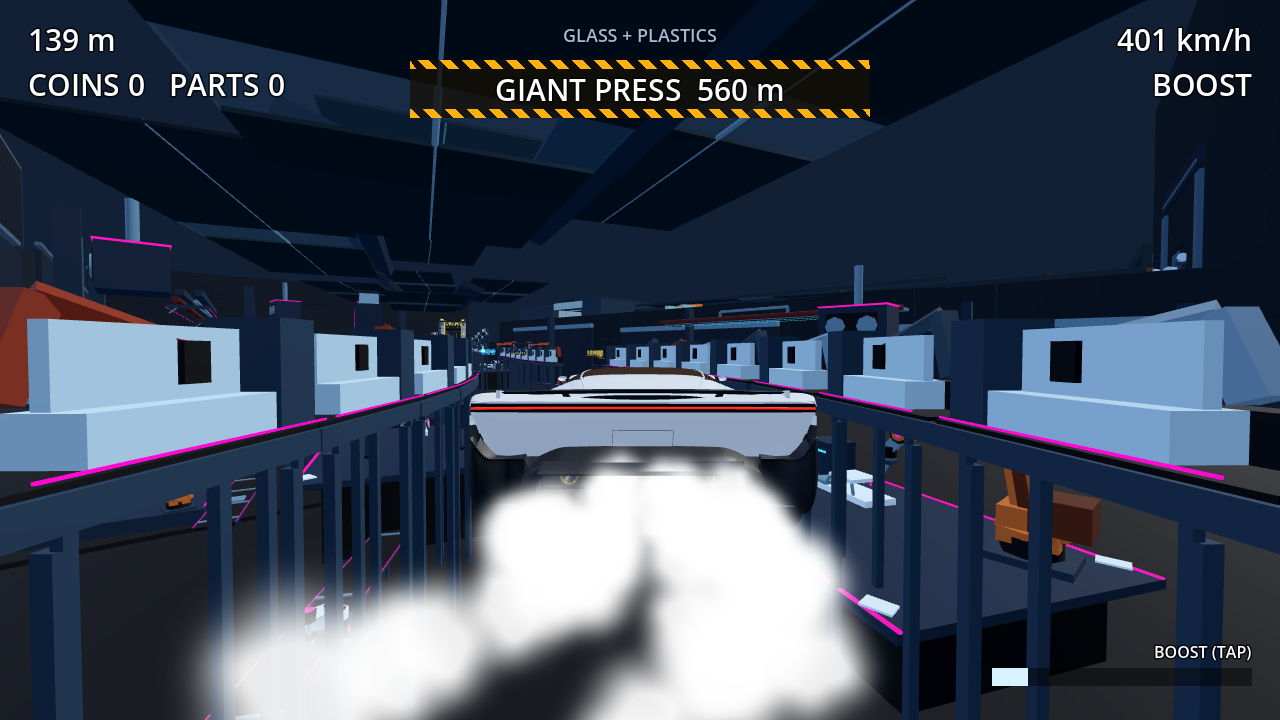
We make CGT Rocket X Racer, a fan-made parody game. It is not a simulator of the real car, and it doesn't recreate the ramp or the kickflip. You fly the CGT Monster, a fictional white rocket car, through a fictional SUPER FACTORY. You dodge giant presses, sweeping robot arms, bear markets, red tape and short drones, and you collect parts to unlock ten skins.
The cold-gas idea does show up in how it plays. Side nozzles move you between lanes without changing pace. Rear boost gives you a ×1.45 speed burst for 1.8 s, then a 3.0 s cooldown, so each boost is a choice rather than something you hold down. More on that in our flight pacing notes. If you want to know what the game itself is (and is not), see the Tesla flying car game FAQ.
Play free in browser on PC + Android on Google Play. On a computer, hit Play to race in Chrome, Edge, Firefox or Safari, with no install. On Android, get it on Google Play. iOS is coming soon.
Free · play in browser on PC · Android on Google Play · iOS coming soon · fan-made parody · invite code 48WYTRMMDW
Get invite on /x/ · Flying car game FAQ · Flying car game page